2025 Part 2
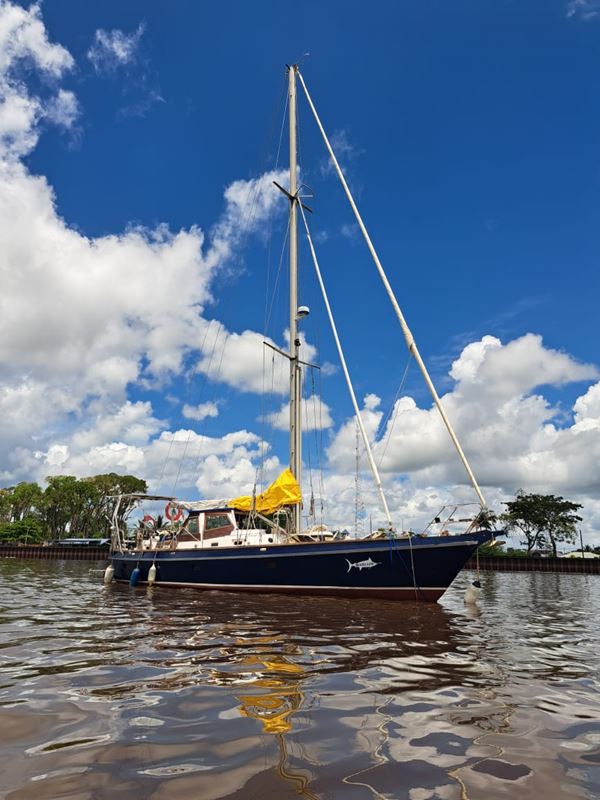
My friend Yayo has bought a 45' steel sloop called 'Marlijn' in Paramaribo, Suriname. His intention is to live aboard, but the boat has been neglected for years and needs work. He has asked Helen and I to help him bring the boat to Portugal where he can find expert services to get it into shape.
I ignore all the red flags and agree to help. After all, how hard can it be to sail a boat from Suriname to Portugal? I’ve done it before, right?
At the beginning of May Helen comes to Makkum and together we fly to Suriname to join Yayo aboard Marlijn in Domburg, a little village outside Paramaribo where there’s a small yacht club on the bank of the Suriname River. I remember it well from my time there on Anjea in 2022.
There are now four of us: Yayo, Wim, Helen and myself with varying levels of sailing experience.
Ever optimistic, I think I might just be able to install a few parts and we’ll have a navigation system that will get us through the Caribbean and across the North Atlantic to Portugal. But I’d completely underestimated what was needed.
16 May 2025
After a chat with Yayo and the crew we figure we can get the boat to the Carib without too much trouble and get parts and some expert work done there.
We leave Domburg at 0900. The plan is to sail to Guadeloupe, a distance of about 800 nautical miles (1500km). The weather forecast is good, with moderate trade winds from the east-northeast and calm seas.
Even that turns out to be problematic. I cannot get the boat to sail well no matter what I try. We are on a reach and it should be easy but the weather helm is atrocious — Helen cannot even hold the wheel! And the autohelm refuses to cooperate. When we finally make it to Saint Louis in Guadeloupe I give it some thought and realize that it is a question of balance. I am used to sailing with a genoa rather than a much smaller and less powerful high-cut yankee jib. The genoa gives much more drive and power to the boat ahead of the mast, especially on a reach. The weather helm was caused by the lack of drive from the little jib alone. I resolve to add more power ahead of the mast by deploying the staysail as well and to flatten and depower the main. We have no more trouble after that.
However, the autohelm is old and tired and just can’t keep the boat on course in any kind of sea state. I suspect the pump is worn out.
Next day, Yayo decides to inspect the bilge and finds it full of water. None of the bilge pumps works, neither the hand pumps nor the automatic electric ones. How had we missed that?
Yayo adjusts the stuffing box, fixes the manual bilge pump and we live with the small drip. It means Yayo has to pump the bilge every few hours but at least we’re not going to sink.
Then the engine overheats. After more than an hour of frustration we track the problem to the ship having two raw water seacocks, one on either side. When the boat was lifted the raw water system lost prime and we had to bleed the system to get it going again. That was easy to figure out but the second seacock was hidden away and we didn’t know of it’s existence until I meticulously traced the plumbing under the engine and found it. We close both cocks, prime the system, open both cocks and the engine runs fine.
The anchor chain locker drips water into the forward cabin making it uninhabitable for Wim and Yayo. They move into the saloon and sleep on the settees and the floor. Not ideal.
In Pointe-à-Pitre, Guadeloupe we spend a few days sorting out some of the problems. The biggest single improvement is getting the auto helm working properly. Yayo simply replaced the entire hydraulics and now it all works.
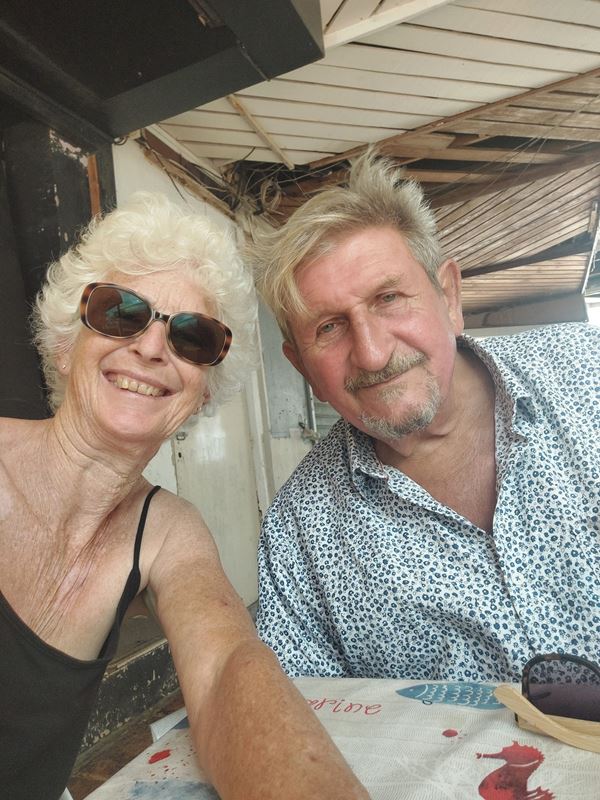
We made further stops in Saint Louis and Bermuda before setting off across the North Atlantic for my favorite islands — the Azores. Helen claims the Azores are just like Ireland, only warm.
A few days out from Bermuda we run out of wind and I go to start the engine. It kind of starts but runs with a horrible noise. After a bit of investigation we discover that the starter key has jammed and that the starter motor is still engaged! The starter is wrecked. With no starter we have no engine.
Sailing back to Bermuda is possible; continuing to Azores under sail alone is also possible if we are lucky with the wind. After studying the weather we decide to press on to the Azores under sail alone. We have about 1,800 nautical miles (3,000km) to go, which will take us around 20 days. The forecast for the next 10 days is good and the climatic conditions in the North Atlantic in July are generally favorable so we feel confident we can make it without too much pain.
Winds are light and variable over the next few weeks. On the plus side the breeze rarely dies completely. If we could’ve started the engine we’d have motor-sailed and been more comfortable. We’d also have had more electricity and we would’ve saved a few days. But in the end it was a good decision to keep going.
18 July 2025
When I start my 0300 watch there is just enuf breeze to move us towards the bottom corner of Faial in the Azores at about 2kn but as the sun rises the breeze drops and we drift along at less than a knot. It is tedious. The autohelm refuses to steer so helming gives me an occupation. Wim and Yayo are up at dawn and as we round the corner of the island the wind dies completely. We drop the dinghy, tie it to Marlijn’s hip, and motor the rest of the way, constantly aware that if the dinghy’s outboard dies or we run out of fuel all we can do is drop anchor. To add to our worries Horta Marina is not answering the radio.
Rounding the SE corner of Faial we see 2kn of current against us. Wim opens the throttle and the little 8HP Mercury does her level best to push us forward. It takes a few moments for her to gather some speed with the 15t mass of Marlijn but she does it and once again we edge forward at a knot or two against the current.
Just before we enter the harbour Horta Marina answers and asks us to anchor just inside. We’d have preferred to tie up alongside but there is nowhere available. Anchoring is straight-forward. With the hook down we look at each other with relief and amazement — we’ve done it!
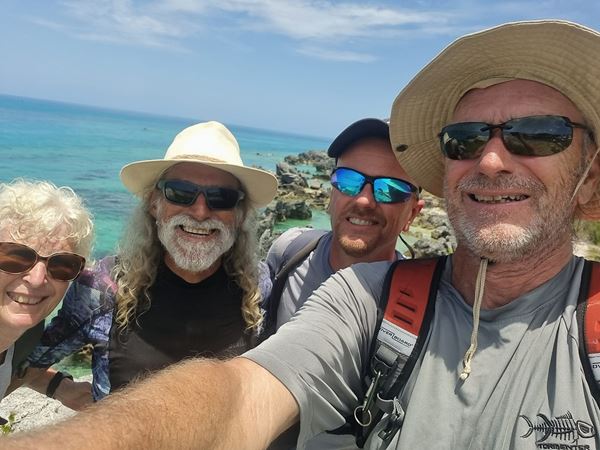
Ashore, we prioritize a shower first, fitting a new starter motor second, followed by a beer for the boys and a GnT for Helen. We gather at Peter’s Sports Cafe for a great afternoon.
19 July 2025
In the evening Helen takes us to Atletico — a beautiful restaurant with unusual decor and furniture in an unexpected neighborhood, opposite the gas refill center! The food is spectacularly good and prices reasonable.
When we return to the marina a Malinese band has set up in a corner facing the water. A hundred or so dinghies and small boats float in front of them with many people simply floating in the water on inflatables or paddle boards. The crowd is young and enthusiastic, the band is good and I like the singer. A great vibe even though I am extremely tired and not really in a state to enjoy it to the full. I desperately needed rest and some alone time.
20 July 2025
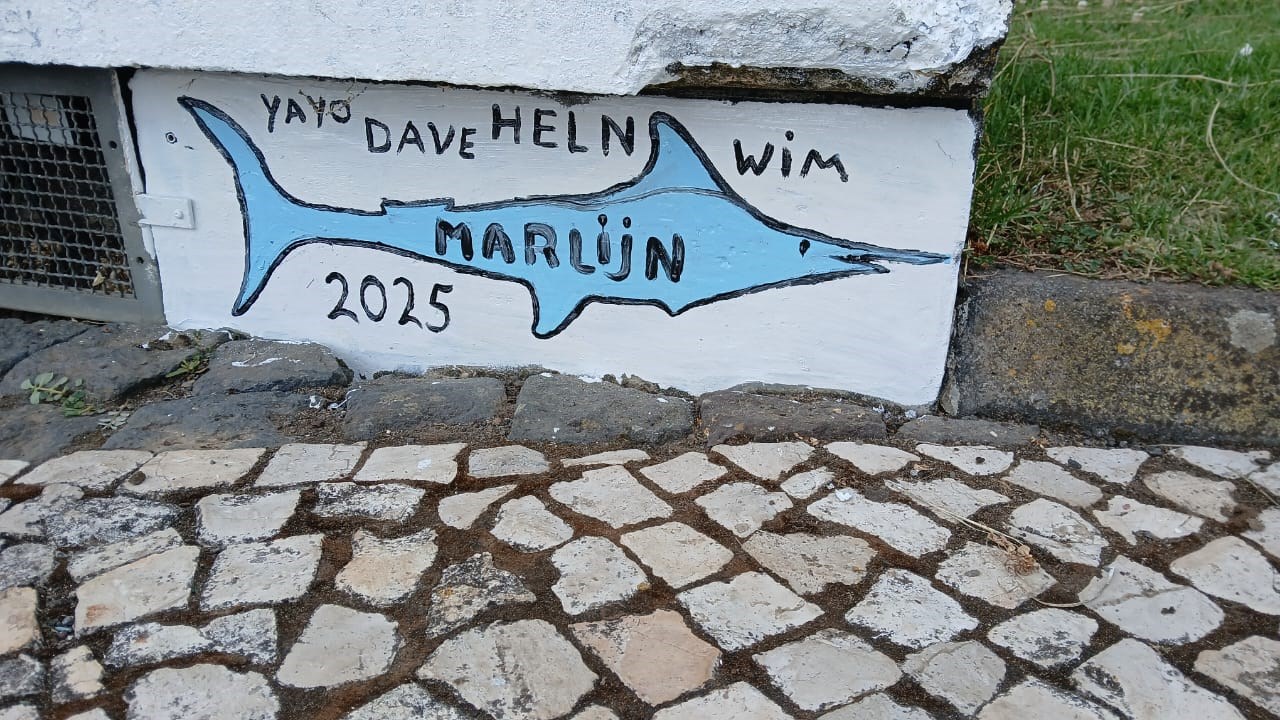
Finally, I have most of a day to myself. The last few weeks have been intense and stressful. I find Merel’s artwork from my last visit to Horta on Anjea and spend a couple of hours climbing the steep track to the church at the top of the hill above Horta. It is a chance to reflect on all that has happened since I was last here in August 2023.
5 August 2025
At 1638 on 5th August we pull into Lagos, Portugal, completing our 4,765 nautical mile (8,825km) voyage from Suriname. It has taken us 81 days altogether, 41 at sea, including our stops in Guadeloupe, Bermuda and the Azores. I have never had so many mechanical problems on a passage, and I have never been so relieved to reach land. But we made it because of the crew’s determination and teamwork, and because of their amazing good spirits. If there is one thing I have learned from this passage it is that attitude is everything.
8 August 2025
Helen returns to Ireland and I return to Anjea in Makkum.
Stay tuned for Anjea 2025 Part 3 to find out how the Anjea refit is progressing…